
Analysis: 84% of nations miss deadline to identify ‘nature-harming’ subsidies by 2025
Standards & regulation: Analysis: 84% of nations miss deadline to identify ‘nature-harming’ subsidies by 2025. Read it as a rules signal that may redefine what must be measured, reported, or proven.
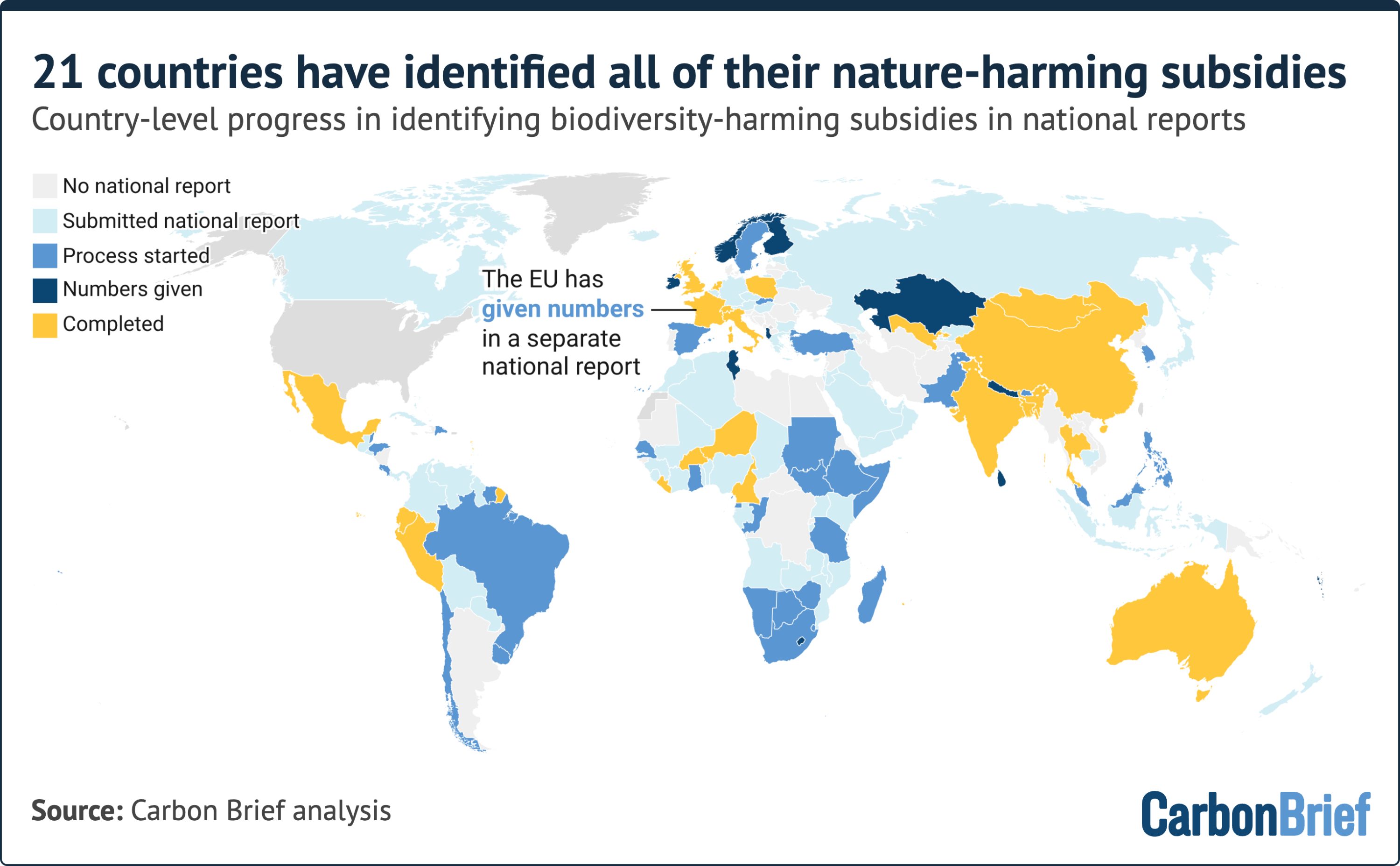
Standards & regulation: Analysis: 84% of nations miss deadline to identify ‘nature-harming’ subsidies by 2025. Read it as a rules signal that may redefine what must be measured, reported, or proven.
Direction visible
Treat this as a reported direction or planned move. The signal matters, but details, enforcement, financing, or delivery may still change.
Scan the signal before reading the analysis.
- Signal level
- Useful Update
- Signal strength
- Useful
- Time horizon
- 0-24 months
- Human impact
- Medium
- Economic impact
- High
- Governance impact
- High
- Confidence
- Medium
What the source is actually reporting.
Print article Share Most countries failed to meet a 2025 target to identify all of their subsidies that could be “harmful” to biodiversity, according to Carbon Brief analysis. The...
Carbon Brief, with topic tags around Uncategorized, analysis, biodiversity.
A rule, standard, or policy direction may change the operating boundary for green work.
Published Jul 28, 2026. GCE classifies it as useful update in Standards & regulation.
The article, rewritten as a brief.
GCE rewrites the reported signal in its own words from the crawled source excerpt, title, source, date, and operating lane. It is a reader-friendly digest, not a copy of the publisher article, and it is not permission to repost the publisher's full text, image, or reporting elsewhere.
Carbon Brief is reporting a useful update connected to standards & regulation. The core reported point is this: Print article Share Most countries failed to meet a 2025 target to identify all of their subsidies that could be “harmful” to biodiversity, according to Carbon Brief analysis. The findings...
For a green-transition reader, the important detail is not only the headline. The story sits inside standards & regulation, where rules change behavior when they define what must be measured, reported, imported, financed, or proven. This means the reported move should be read through market access, evidence, delivery capacity, buyer behavior, and the operating boundary it may change.
The timing also matters. The item was published on July 28, 2026, and GCE classifies it as useful update with medium confidence. That means the direction is visible enough to watch, but the practical outcome still depends on follow-through, implementation details, and whether other sources confirm the same movement.
The useful takeaway is practical: keep the source fact separate from the interpretation, then ask what must be checked next. For this brief, the next checks are who gains access, who faces pressure, what proof is required, which suppliers or buyers are affected, and whether the reported change becomes a repeatable pattern rather than a single news item.
Chip reads this as a green-transition signal, not just a headline: Print article Share Most countries failed to meet a 2025 target to identify all of their subsidies that could be “harmful” to biodiversity, according to Carbon Brief analysis. The...
In Standards & regulation, rules change behavior when they define what must be measured, reported, imported, financed, or proven.
The decision test is practical: does this change evidence, cost, delivery, risk, buyer access, or the next operating step?
The consequence is more important than the headline.
Standards and regulation change what must be proven before a project, product, or claim can scale.
Project Impact
Project teams need to translate the rule into affected products, suppliers, documents, and deadlines.
Business Impact
Regulation can raise compliance cost, but it can also reward companies that prepared evidence early.
Governance Impact
Standards turn abstract climate ambition into a practical boundary for markets and operations.
Market System Impact
When rules harden, they reset the baseline for what credible green economy participation means.
Follow the incentives, not the announcement.
- Compliant operators: They gain when clear standards reward earlier preparation.
- Regulators and buyers: They gain leverage when evidence requirements become explicit.
- Unprepared suppliers: They face cost and access pressure when requirements become enforceable.
- Ambiguous claims: They become harder to defend once standards define the proof boundary.
Trust improves when the angles are visible.
The priority is turning ambition into enforceable evidence.
The risk is missing deadlines or underestimating documentation work.
The practical question is what must be measured and by when.
Primary action: Prepare
- Map the rule to products, suppliers, and reporting deadlines.
- Identify evidence gaps before enforcement arrives.
- Translate policy language into one operating checklist.
This signal belongs to a wider GCE category pattern.
 Environmental Health News · Aug 21
Why cancer, not affordability, may be the biggest issue in Iowa’s midterms
 Environmental Health News · Aug 21
Germans could save over €12,000 by ditching gas boiler for solar, battery and heat pump
 Environmental Health News · Aug 21
Water from plastic bottles — including expensive brands — contains more chemicals than water stored in glass
Source and evidence still matter.
This page is a Chip interpretation of the original article. It is not the original article. Please read the original source for the full report.
Source: Carbon Brief · Published Jul 28, 2026.
What readers are saying.
No comments yet
Analysis: 84% of nations miss deadline to identify ‘nature-harming’ subsidies by 2025
This brief does not have any reader comments yet.